
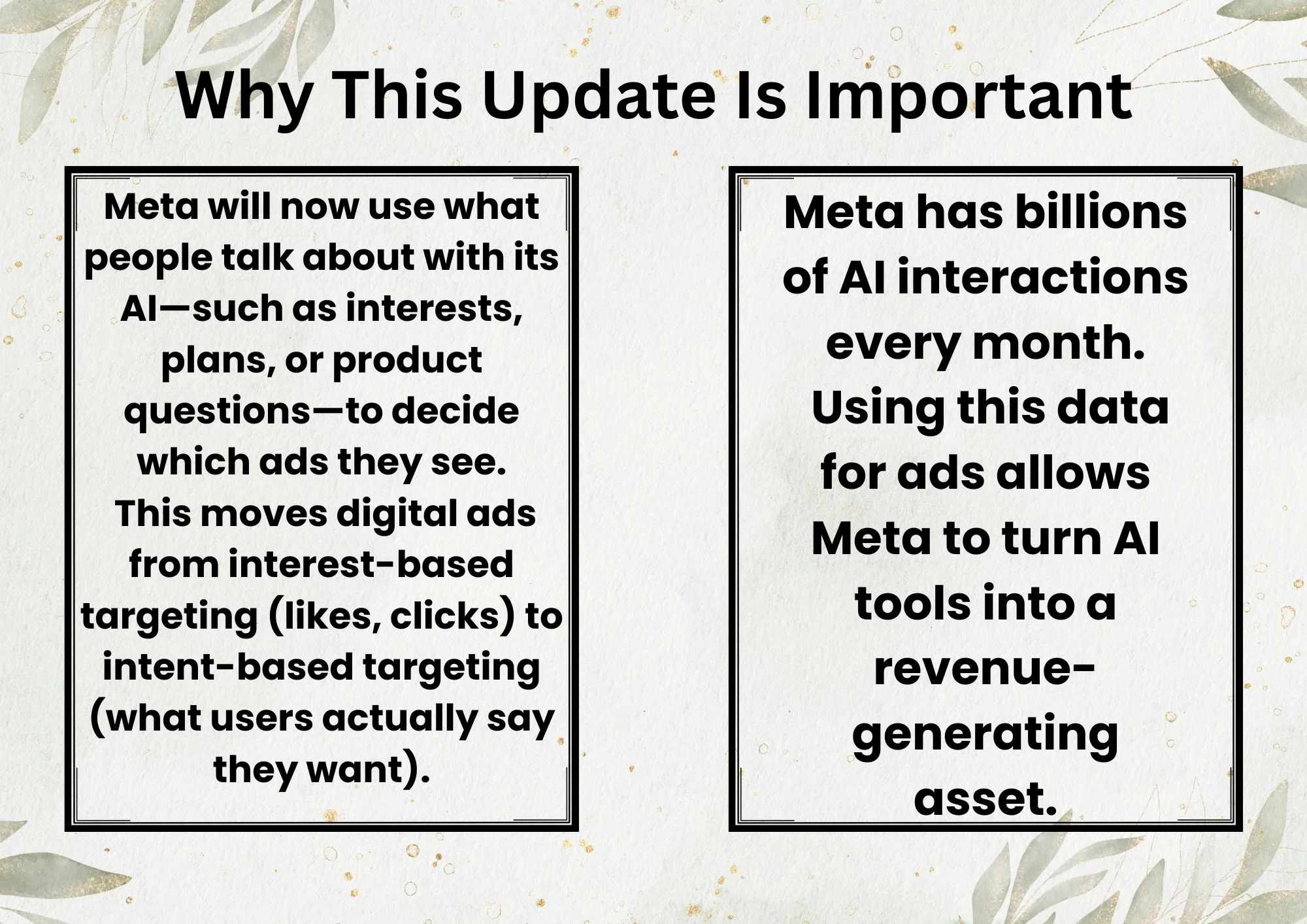
Meta Platforms AI Chat Data to Target Ads marks one of the most defining changes in the evolution of digital advertising. Meta has announced that starting December 16, 2025, conversations with its artificial intelligence tools — whether through voice or text — will be used to influence the ads and content users see across Facebook, Instagram, Messenger, and WhatsApp. This update reorients the very foundation of online targeting: instead of simply observing what users click, like, or follow, Meta is now turning to what they say.
That means a simple query such as “Recommend the best trekking backpacks for winter expeditions” or “Show me good Hindi romantic films” could instantly become marketing triggers. In a matter of minutes, ads for trekking gear, outdoor clothing, or film-streaming platforms may populate your feed. This change positions Meta Platforms AI chat data to target ads as one of the most powerful signals ever introduced to the digital advertising ecosystem.
Meta calls this evolution a way to offer “more relevant recommendations.” But beneath the marketing promise is a new conversation about privacy, consent, transparency and the commercial future of AI-driven platforms.
Hyper-Personalization and Marketing Impact — Meta Platforms AI Chat Data to Target Ads
For marketers, this update is nothing short of revolutionary. For years, Facebook’s ad engine inferred intent: liking Adidas pages, watching marathon videos, and browsing sports-gear posts suggested a user might be a runner. Now, inference is no longer required.
If a user directly tells Meta AI “Which shoes are best for marathon training?” that signal becomes immediate ad data.
Implications for advertisers and creators:
-
Targeting based on real interest rather than historical behavior
-
Higher chance of matching users to products when they are actively researching
-
A shorter journey from discovery to purchase
Creators, meanwhile, may see content distribution shift towards real-time interests rather than past engagements. The digital ecosystem becomes intent-led, not algorithm-inferred.
Consent, Transparency and Regulation — Meta Platforms AI Chat Data to Target Ads
Although AI conversations are not the same as private direct messages, the shift introduces a new question for billions of users:
“When I talk to AI, am I speaking privately or commercially?”
With Meta Platforms AI chat data to target ads, the answer is layered:
-
AI conversations are not publicly viewable — but they influence ads and content
-
There is no full opt-out if users want to continue using Meta AI tools
-
For low-activity users who rarely like or share posts, AI chats may become the main source of targeting data
This changes how people view AI assistance. A harmless shopping query may instantly feed into Meta’s commercial pipeline. To some, this feels like helpful personalization. To others, it feels like an unexpected level of surveillance.
Privacy Debate and User Rights — Meta Platforms AI Chat Data to Target Ads
Meta has stated that its system will not use AI chat interactions to infer sensitive traits such as political affiliation, sexual orientation, religion, or medical status. However, privacy experts warn that conversational data is inherently more revealing than likes or clicks.
Why the concern?
-
Conversational prompts expose emotional context
-
Users often speak more freely to AI than they do publicly
-
AI might identify patterns people did not intend to share
Meanwhile, early studies show that ad-preference controls may not fully block unwanted categories in AI-driven systems. Here, personalization and privacy are in direct conflict — AI delivers convenience, while users face increasingly granular profiling.
Content and Ad Strategy Evolution — Meta Platforms AI Chat Data to Target Ads
The meaning of engagement on Meta’s platforms has officially changed. Likes, shares and comments matter — but they are no longer the most powerful signals. Now, conversation is the new engagement.
Marketing implications:
-
Conversational campaigns may outperform classic feed ads
-
Businesses may develop chatbots to collect intent signals like AI does
-
Retargeting may shift toward intent segments such as:
-
“Planning to travel soon”
-
“Researching smartphone upgrades”
-
“Buying holiday gifts”
-
Creators may prioritize problem-solving and answer-focused content rather than personality-centric posting. Meanwhile, brands will need to implement ethical data practices and clear consent mechanisms to avoid regulatory risk and build user trust.
Global Implications and Digital Advertising Future — Meta Platforms AI Chat Data to Target Ads (H2 with focus keyword)
Meta’s update arrives during growing international scrutiny of AI, profiling and data privacy. The European Commission has already launched investigations into Meta’s deployment of AI tools in messaging platforms. More oversight is expected.
Legal questions ahead:
-
Must Meta inform users explicitly when AI chats influence ads?
-
Should users have a full opt-out from AI-based targeting?
-
What happens when AI infers sensitive traits unintentionally?
Academia adds another twist: LLM-generated ads have proven to be more persuasive than human-written ads, especially when aligned with psychological triggers. This increases concerns about manipulation — if AI can identify emotional vulnerability and target ads accordingly, where is the ethical boundary?
The next few years may determine whether AI-driven advertising becomes:
-
a breakthrough in personalization
or -
a catalyst for a major global privacy battle
Either way, the shift is now irreversible.
The Bigger Implications — Meta Platforms AI Chat Data to Target Ads (H2 with focus keyword)
This transformation is more than a technical update — it is a philosophical redefinition of online interaction and data monetization.
For marketers, it represents unprecedented precision — the closest form of targeting to “declared intent.”
For users, it creates a new trade-off:
-
smarter recommendations, but
-
with conversational data as the price of entry
For governments and regulators, it marks the official beginning of the AI-advertising era, requiring new laws designed specifically for conversational data.

A deep dive into how Meta Platforms AI chat data to target ads is reshaping digital marketing, privacy expectations, and the future of personalized advertising.
Final Takeaway
Meta’s decision to integrate Meta Platforms AI chat data to target ads marks a turning point in the digital ecosystem. It promises heightened relevance for advertisers, better recommendations for users, and a future in which privacy and personalization will be continuously negotiated.
AI-powered advertising is no longer about what we click —
it is about what we say.




No comment