

In the fast-paced world of digital marketing, Content Automation and AI Copywriting have emerged as revolutionary tools for brands and marketers. The demand for fresh, relevant, and high-quality content has grown exponentially — and traditional content creation methods often struggle to keep up. This is where automation and artificial intelligence (AI) step in, offering smarter, faster, and more data-driven ways to create content that connects with audiences.
But this transformation isn’t just about saving time or cutting costs. It’s about enhancing creativity, improving personalization, and enabling marketers to deliver value at scale. From small businesses to global enterprises, everyone is beginning to realize that Content Automation and AI Copywriting aren’t the future — they’re the present.
Understanding Content Automation and AI Copywriting
At its core, Content Automation & AI Copywriting refer to the use of advanced AI tools and automation systems to generate, optimize, and distribute written content across multiple platforms. These systems leverage natural language processing (NLP), machine learning (ML), and data analytics to understand context, tone, and audience behavior.
In simpler terms, imagine having an intelligent assistant that can:
Write blog posts in minutes,
Generate engaging social media captions,
Draft personalized email campaigns, and
Optimize all of it for SEO — instantly.
That’s the power of Content Automation and AI Copywriting. Tools like ChatGPT, Jasper, Copy.ai, and Writesonic are prime examples of how AI is transforming the creative process, making it more efficient without losing the human touch.
Learn More About Our Course Modules
How AI Copywriting Works
AI copywriting systems use massive language models trained on billions of words from books, websites, and articles. When given a prompt — for example, “Write a blog post about healthy eating” — the AI predicts the most likely words and phrases that should come next, based on its training data.
These models are capable of adapting to tone, style, and context, which means they can write anything from a professional LinkedIn post to a casual Instagram caption.
The true strength of Content Automation and AI Copywriting lies in its ability to learn and improve over time. As marketers interact with these tools, provide feedback, and guide their outputs, the AI becomes smarter, more relevant, and more aligned with brand voice.
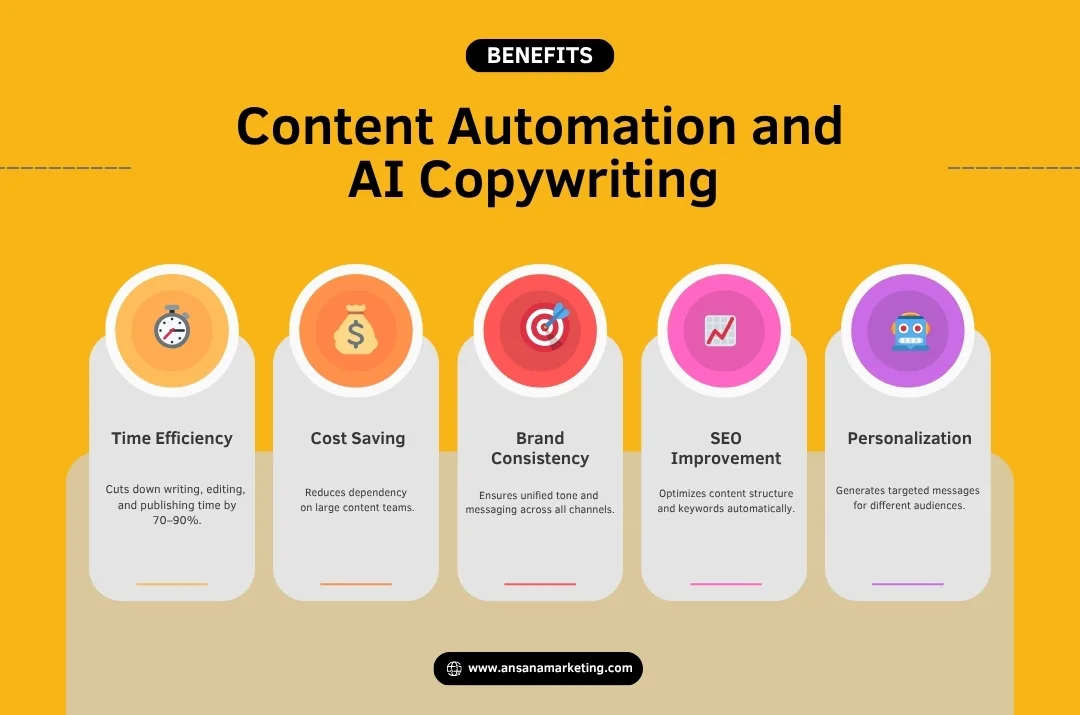
Why Content Automation Matters in 2025
The digital marketing landscape in 2025 demands speed, personalization, and consistency. Traditional content creation often struggles with scale and time constraints. AI-based automation bridges this gap.
Here’s why Content Automation & AI Copywriting are so valuable today:
1. Faster Content Production
Marketers can produce blog articles, social media posts, product descriptions, and newsletters within minutes instead of days. This helps brands maintain an active online presence and respond to trends in real time.
2. Cost Efficiency
Hiring large content teams can be expensive. AI tools reduce the cost per piece of content while maintaining — or even enhancing — quality.
3. Personalization at Scale
AI can analyze data from user interactions, demographics, and preferences to create personalized messages for each customer segment. Imagine sending 1,000 unique emails tailored to individual behaviors — that’s Content Automation and AI Copywriting in action.
4. Consistency and Brand Voice
AI tools can be trained to maintain a specific tone or brand personality across platforms. Whether you’re writing an ad or an email, the message feels consistent.
5. SEO Optimization
Modern AI copywriters can automatically integrate keywords, headings, and meta descriptions, ensuring content is optimized for search engines without compromising readability.
Follow us on Instagram for daily AI Marketing hacks!
Humanizing AI-Generated Content
A common misconception is that AI-generated content feels robotic or lacks emotion. However, when used strategically, Content Automation and AI Copywriting can produce deeply human, relatable, and authentic messages.
The key lies in collaboration.
AI provides the speed and structure, while human creativity brings empathy, storytelling, and nuance. Together, they form a powerful partnership.
For example:
A marketer uses AI to draft a blog outline.
The human editor refines the tone, adds anecdotes, and ensures emotional resonance.
AI then re-optimizes it for SEO and readability.
This blend of machine efficiency and human insight creates content that not only ranks well but also builds trust and connection.
Popular Tools for Content Automation and AI Copywriting
Here are some widely used tools that define the modern marketing ecosystem:
ChatGPT – Ideal for blogs, long-form articles, and brainstorming creative ideas.
Jasper AI – Specializes in branded tone of voice and marketing copy.
Copy.ai – Great for ad copy, social posts, and taglines.
Writesonic – Offers templates for e-commerce, landing pages, and product descriptions.
HubSpot AI Content Assistant – Integrates automation directly into CRM workflows.
Each of these tools demonstrates how Content Automation and AI Copywriting can enhance efficiency, boost creativity, and support different stages of the content lifecycle.

Challenges and Ethical Considerations
While AI offers incredible advantages, there are important challenges to address:
Authenticity: Overuse of AI may lead to generic or repetitive content.
Bias: AI systems reflect the biases present in their training data, which can lead to unintentional stereotypes.
Originality: Since AI is trained on existing content, ensuring unique output is essential.
Transparency: Brands should disclose when AI-generated content is used, especially in journalism or education.
A responsible approach to Content Automation and AI Copywriting means balancing innovation with ethics — ensuring technology empowers creativity without replacing human integrity.
The Future of Content Automation and AI Copywriting
Looking ahead, Content Automation and AI Copywriting will continue to evolve from simple text generation to complete content ecosystems. Future systems may handle:
End-to-end marketing campaigns,
Voice and video scripting,
Real-time content personalization, and
Predictive engagement (content that adapts dynamically to user behavior).
AI will not replace content creators; it will elevate them. By automating repetitive tasks, writers can focus more on creative strategy, storytelling, and emotional impact — the things that machines can’t replicate
In today’s digital age, Content Automation and AI Copywriting have become indispensable for marketers seeking to scale their efforts, maintain consistency, and engage audiences intelligently. These technologies empower businesses to produce content faster, more affordably, and with greater precision — while still leaving room for human creativity to shine.
The key takeaway?
AI is not a replacement for human imagination; it’s an enhancement. Marketers who learn to blend automation with empathy, data with creativity, and logic with emotion will lead the next era of digital communication.
As the lines between human and machine collaboration blur, Content Automation and AI Copywriting will redefine what it means to create — making marketing smarter, faster, and infinitely more personal.




No comment