

In today’s digital-first world, brands are increasingly focusing on smaller, more precise audiences. Instead of trying to reach everyone, they aim to reach the right ones—those who are most likely to buy, engage, and become loyal customers. This is where Hyperlocal Marketing comes into play.
This strategy focuses on targeting potential customers in a specific geographic area—sometimes as narrow as a few city blocks or even a single neighborhood. For small businesses, franchises, and even national brands with local outlets, Hyperlocal Marketing has become one of the most powerful tools to attract and retain customers.
What is Hyperlocal Marketing?
Hyperlocal Marketing is a digital marketing strategy that targets customers in a very specific location. The primary goal is to connect with audiences who are physically close to your business or who search for products and services “near me.”
For example, imagine you run a coffee shop in downtown Chicago. Instead of targeting “coffee lovers in the U.S.,” you focus on “coffee shops near me” or “best latte in downtown Chicago.” This ensures your business appears in front of people who can actually visit you today.
This approach blends location-based targeting, mobile optimization, and personalized content to drive real-world foot traffic and conversions.
Why Hyperlocal Marketing Matters in 2025
In 2025, consumers expect convenience and immediacy. Whether they’re looking for a plumber, a boutique, or a pizza delivery, they want options close to home—and fast. That’s why Hyperlocal Marketing is more relevant than ever.
Here’s why it’s becoming a top priority for businesses of all sizes:
Voice Search and Mobile Dominance
Over 60% of local searches come from mobile devices, and most include phrases like “near me.” Hyperlocal strategies ensure you show up where these users are searching.
Google’s Local Search Updates
Google continually enhances its local algorithms, rewarding businesses with accurate location data, local content, and positive reviews.
Consumer Trust in Local Businesses
People trust local businesses more. By using Hyperlocal Marketing, you align your brand with authenticity and community connection.
Better ROI
Because your campaigns are narrowly targeted, ad spend becomes more efficient. Every impression counts because it reaches people likely to convert.
Core Elements of an Effective Hyperlocal Marketing Strategy
Building a strong Hyperlocal Marketing strategy involves integrating several key components. Let’s break them down.
1. Google Business Profile Optimization
Your Google Business Profile (formerly Google My Business) is the foundation of local visibility. Optimize it with:
Accurate business name, address, and phone number (NAP).
High-quality photos and videos.
Customer reviews and quick responses.
Regular updates and posts.
This helps you appear in Google Maps and local search results when customers look for nearby services.
2. Local SEO and Keyword Targeting
Use city-specific and neighborhood-based keywords in your website content, meta tags, and blogs.
Try using “digital marketing agency in Brooklyn” instead of “digital marketing agency,” for instance.
Combine this with schema markup and local backlinks from community directories or local news sites to boost your ranking.
3. Geofencing and Location-Based Ads
With geofencing, you can draw a virtual boundary around your target area and show ads to people within that zone. Retailers, restaurants, and event organizers use this Hyperlocal Marketing tactic to drive immediate visits or purchases.
For instance, a restaurant can send a discount notification to users walking within 500 meters of its location during lunch hours.
4. Localized Social Media Campaigns
Social media platforms like Facebook, Instagram, and TikTok allow advanced location targeting.
You can run hyper-targeted ads that reach people in a specific zip code, neighborhood, or radius. Combine local hashtags, stories, and community engagement to strengthen your presence.
5. Community Partnerships and Events
Nothing builds local trust faster than being part of the community. Sponsor local events, collaborate with nearby businesses, or host workshops. These initiatives make your brand more relatable and memorable.
Offline engagement complements digital Hyperlocal Marketing, creating a holistic brand experience.
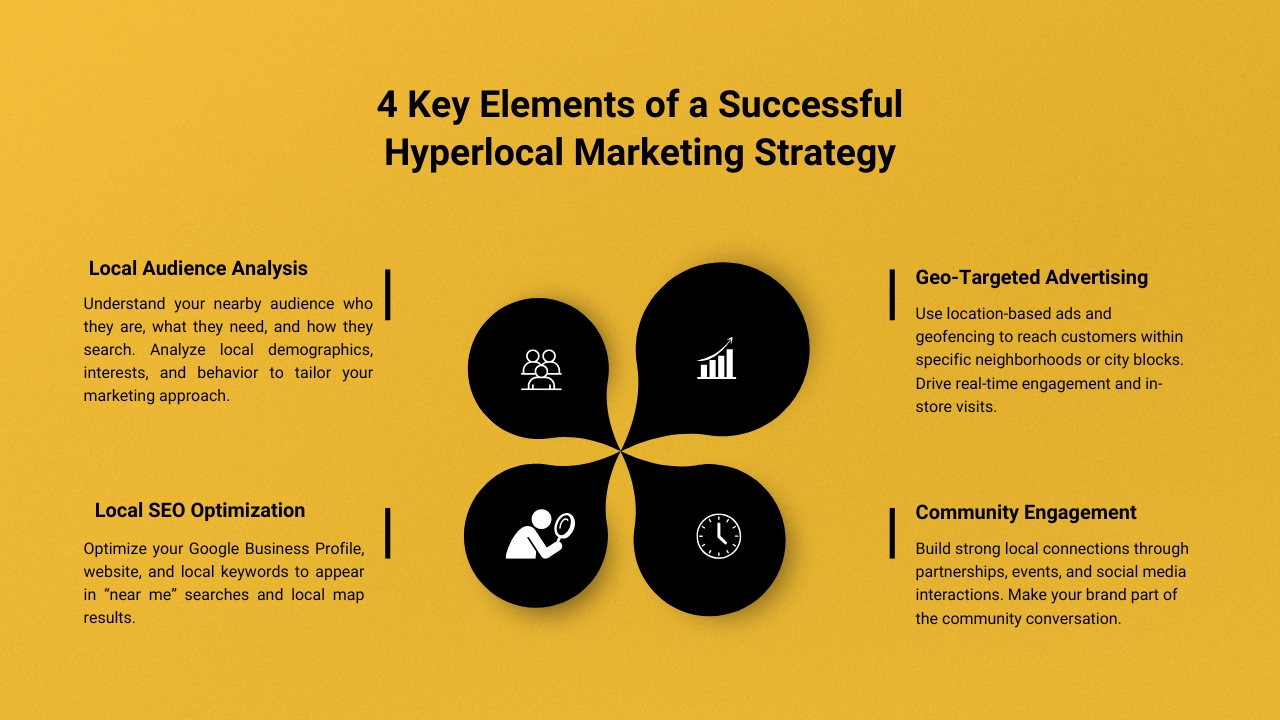
Examples of Successful Hyperlocal Marketing Campaigns
Let’s explore how brands are creatively applying Hyperlocal Marketing to connect with customers.
Starbucks:
Starbucks uses app-based location targeting to send time-sensitive offers when users are near their stores. The brand also tailors local menus and promotions based on regional tastes.
Domino’s Pizza:
Domino’s combines GPS tracking and push notifications to promote instant offers when users are near a franchise. This real-time approach significantly boosts foot traffic and conversions.
Local Boutiques and Salons:
Many small retailers use localized Instagram ads and Google Map listings to attract nearby shoppers. Offering exclusive local discounts or loyalty programs enhances repeat business.
Benefits of Hyperlocal Marketing
Increased Foot Traffic:
By targeting customers nearby, you drive more in-store visits and spontaneous purchases.
Higher Conversion Rates:
People searching locally are ready to buy—meaning your conversion rates skyrocket compared to broader campaigns.
Enhanced Customer Relationships:
Localized campaigns feel personal, helping you build lasting relationships with your community.
Cost Efficiency:
Focused targeting means less wasted ad spend and higher ROI.
How to Measure Hyperlocal Marketing Success
To evaluate how well your Hyperlocal Marketing efforts are performing, monitor:
- Local search rankings (especially in Google Maps).
- Foot traffic and store visits (using Google Analytics and location tracking tools).
- Click-through rates (CTR) for location-based ads.
- Customer reviews and engagement on local platforms.
- Sales or inquiries generated from hyperlocal campaigns.
- Continuous testing and optimization help you fine-tune your strategy and stay competitive in your area.
The Future of Hyperlocal Marketing
As AI, geolocation data, and augmented reality evolve, the future of Hyperlocal Marketing looks even brighter. Businesses will soon be able to deliver ultra-personalized experiences—like sending AR coupons when someone walks by a store window or recommending nearby deals through voice assistants.
Brands that embrace these innovations early will dominate local markets and build loyal communities.

Conclusion
Hyperlocal Marketing is not just a trend—it’s a necessity for any business that depends on local customers. By combining smart data, local SEO, personalized ads, and genuine community engagement, you can reach the right people at the right time, right where they are.
Whether you’re a neighborhood café, a healthcare clinic, or a national chain with local branches, Hyperlocal Marketing empowers you to build deeper connections and drive real-world results—one neighborhood at a time.
Learn more about advanced digital marketing strategies at Trazi Digital Academy
Explore our Digital Marketing Certification Course to master hyperlocal and geo-targeted campaigns.




No comment