
In December 2023, Google introduced ‘Gemini, a powerful AI model that marks a major milestone in how we interact with digital intelligence. Far more than a chatbot, Gemini blends natural conversation, reasoning, and media understanding — all in one place. But behind the tech is a bigger story: one of competition, innovation, and how AI is beginning to reshape our daily lives.
What Makes Gemini Different?
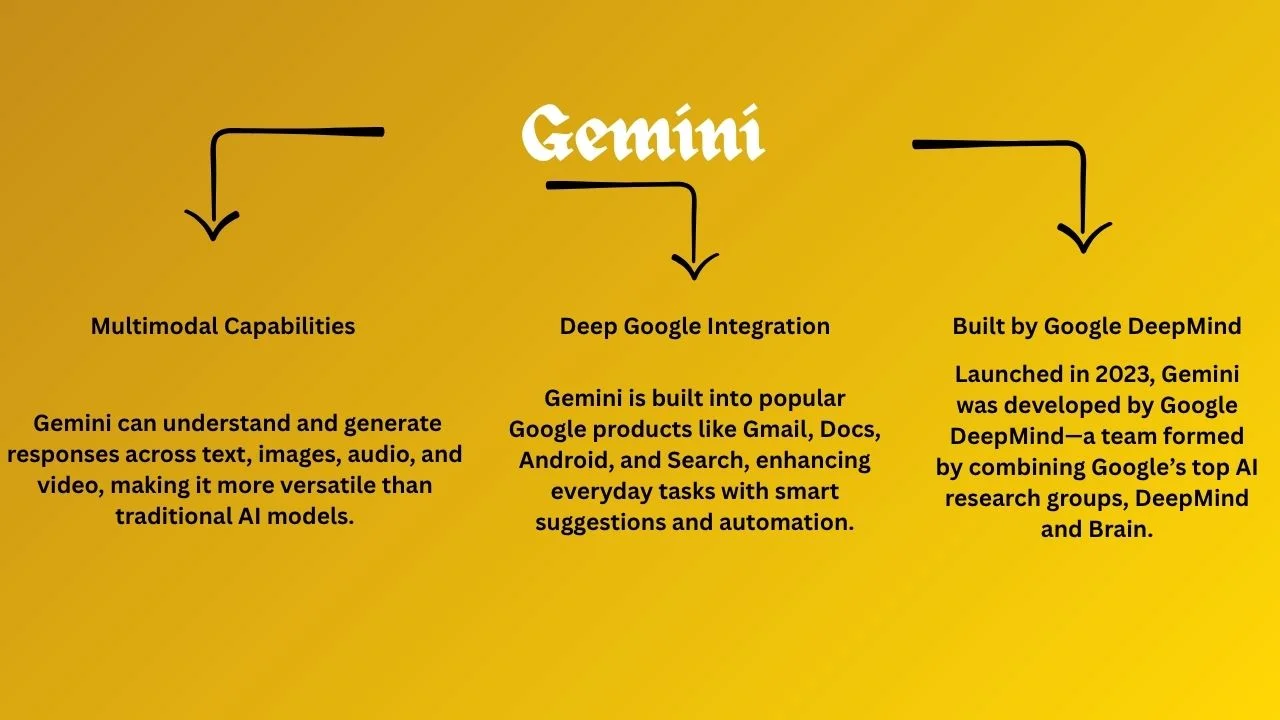
Gemini came to life in 2023, after Google brought together the strengths of its two leading AI teams — DeepMind and Brain. By uniting them under one roof, called Google DeepMind, the company laid the foundation for building something far more powerful and collaborative than ever before.
“Powered by innovation, guided by intelligence — Google Gemini insights at TRazi Digital Academy.”
Gemini vs. the Competition;
When it comes to competition, Gemini’s most direct challenger is Open AI’s Chat GPT — particularly the advanced GPT-4 and GPT-4o versions, which have set the benchmark for conversational AI in recent times.. Chat GPT became popular fast and set the standard for friendly, fluent AI conversations. But Google has an edge in scale and integration. It can plug Gemini into tools millions already use — like Gmail, Docs, Maps, and YouTube.
Other competitors include Anthropic’s Claude, Meta’s LLaMA, and Mistral, but the real battle right now is between **Google and OpenAI ChatGPT.
This rivalry is intense — and personal. Many of OpenAI’s founders once worked at Google. Now, the race is on to build the most helpful, safest, and most advanced AI on the planet.
A More Helpful Kind of AI
One thing Google gemini emphasizes is that just smart — it’s designed to be helpful. You can already see it in action inside:
Google Workspace: can draft emails, summarize long threads, and help create slides.
Pixel Phones: powers call screening, photo editing, and personal suggestions.
Coding Tools: Developers get real-time help through Gemini-based code assistants.
In short, Google is embedding Geminacross its entire ecosystem — making it more useful every day.
Looking Ahead
The first versions — Gemini 1 and 1.5 — were powerful, but the next iterations (likely 2 and beyond) are expected to be even more capable. Features like long-term memory, better context retention, and deeper personalization are on the horizon.
, replacing Google Assistant. That would bring this AI to billions of users — putting it in your pocket, on your desk, and in your daily life.
Of course, with great power comes great responsibility. Google says it’s building Gemini with safety, privacy, and fairness in mind — but as with any AI, trust will depend on real-world performance.
Why It Matters
AI is more than just tech — it’s about how we live, work, and connect. Google is betting that the future of computing isn’t just in screens or searches, but in smart, conversational systems that work *with* us.
Whether it’s helping a student learn faster, assisting a doctor with research, or guiding a traveler through a foreign city — represents a more natural way to use digital tools.
It’s not perfect. But it’s evolving fast. And it’s already changing how we think about technology.
Fun Fact
The name could be a nod to the twins of mythology — Castor and Pollux — symbolizing dual capabilities like reasoning and creativity. It might also reference the NASA program, which trained astronauts for the Moon landing — a fitting symbol for what could be AI’s biggest leap yet.

“Getting hands-on with Google Gemini at TRazi Digital Academy — where learning meets the future!
Final Thoughts
Gemini isn’t just another AI model — it’s a signal that the next phase of the internet is already here. And Google, with its tools, talent, and user base, is making a serious play to lead it.
The future isn’t about machines replacing humans. It’s about machines that understand humans. might just be the first step in making that future real.




No comment