
The field of digital marketing has seen substantial change in recent years due to the development of AI and Automation in Digital Marketing. These effective techniques are becoming essential parts of contemporary marketing strategy rather than futuristic ideas. The ability of machines to replicate human intelligence and carry out operations like learning, reasoning, analyzing, and decision-making is known as artificial intelligence, or AI. Contrarily, automation is the process of using technology to complete activities without the need for human involvement. Together, AI and automation are radically altering how organizations engage with their clientele, choose the most effective ways to market to them, and manage their operations.
The Power of Data: How AI and Automation in Digital Marketing Transforms Consumer Insights into Action
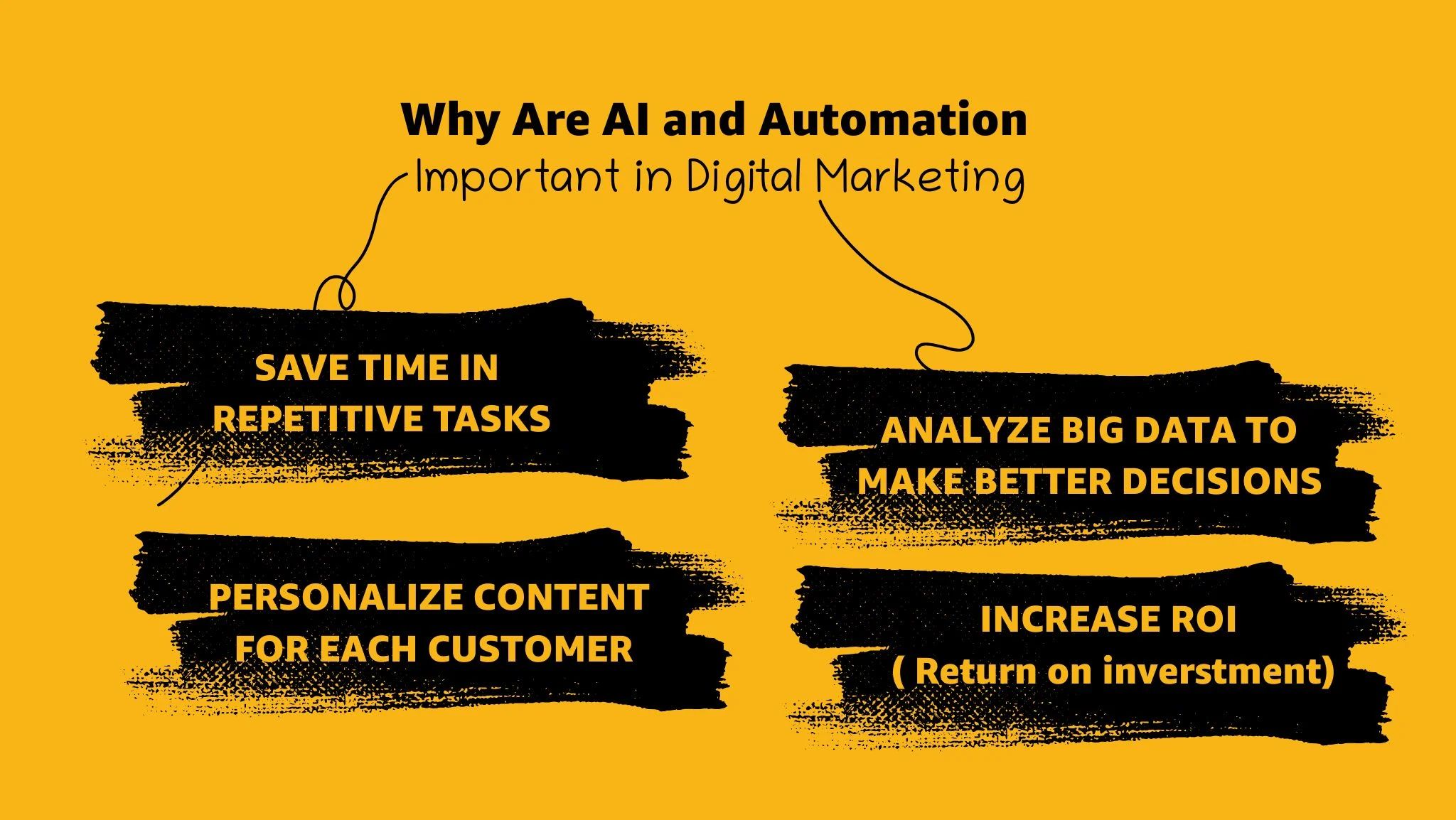
Data is at the center of this change. Data is produced by every internet activity, from Google searches to Instagram post likes. Massive volumes of data can be analyzed by AI systems at incredibly fast speeds, revealing patterns, preferences, and behaviors that would take humans a lot longer to figure out. Marketers may make more informed decisions based on data thanks to this in-depth knowledge. AI-powered solutions are able to segment audiences, forecast consumer behavior, tailor content, and even suggest things that a user is likely to purchase next. AI and Automation in Digital Marketing is used, for instance, when you browse Amazon and receive product recommendations based on your previous searches or purchases.
Because it handles time-consuming, repetitive tasks, automation performs a crucial supporting function. One area where automation has had a significant impact is email marketing. Now, marketers can create whole email campaigns that react automatically to consumer behaviors, such as sending a follow-up email following a purchase, a welcome email upon subscription, or a reminder email when a client leaves products in their basket. Businesses may automate these procedures with the help of tools like Mailchimp, HubSpot, and ActiveCampaign, which guarantee a consistent client experience while saving time and increasing efficiency.
Streamlining Social Media: How AI and Automation in Digital Marketing Enhances Content and Engagement
Another area where automation and AI excel is social networking. Facebook, Instagram, LinkedIn, Twitter, and other social media networks have billions of users, making manual social media management daunting. With the help of automated features offered by social media management platforms like Buffer, Hootsuite, and Sprout Social, marketers can plan posts, track engagement, and evaluate results all in one location. AI takes one step further by determining the optimal times to publish, figuring out what kinds of content work best, and even coming up with ideas for new posts or creating captions. AI can automatically identify possibly dangerous or incorrect user comments or suggest the best content mix in certain sophisticated systems.
One well-known example of how AI enhances the consumer experience is chatbots. Natural language processing (NLP), a branch of artificial intelligence, is used by these automated chat systems to comprehend and react to user inquiries instantly. Without the need for human operators, chatbots can manage thousands of interactions at once and offer round-the-clock customer service. They are extensively utilized on chat apps, websites, and even WhatsApp. A consumer can use a chatbot, for example, to check the status of their order, ask about the availability of a product, or obtain help with a return. Advanced AI chatbots learn and get better over time, becoming more responsive and helpful than basic bots, which operate on simple rule-based systems.
AI and Automation in Digital Marketing is used in content marketing to create, choose, and enhance content. Product descriptions, blog pieces, ad copy, and social media postings may be written in a matter of seconds using programs like Writesonic, Copy.ai, and Jasper AI. AI can offer drafts, ideas, and headlines that marketers can build upon, but human ingenuity still dominates when it comes to storytelling and brand voice. A more strategic approach to content development is made possible by AI’s assistance in finding trending subjects, optimizing content for search engines, and monitoring content performance.
Optimizing for Intent: AI’s Role in Modern SEO
AI has also changed search engine optimization (SEO), a fundamental component of digital marketing. AI-powered tools like SEMrush, A hrefs, and Surfer SEO can now handle keyword research, competitor analysis, on-page SEO recommendations, backlink analysis, and even technical SEO audits. AI is used by Google’s search algorithm to rank content and comprehend human intent. Google has shifted from matching keywords to comprehending the context and meaning of search queries via Rank Brain and BERT. Therefore, rather than just jamming keywords into their material, marketers should concentrate more on producing useful, user-friendly content.
AI and automation have also greatly benefitted pay-per-click (PPC) advertising. AI is used by platforms such as Google advertisements and Meta Ads (Facebook/Instagram) to target advertisements to users who are most likely to convert, optimize bidding tactics, and choose the best-performing creatives. Campaign objectives, such as optimizing clicks, conversions, or impressions, can be established by marketers, and the platform’s AI will make real-time adjustments to bidding and placements. For example, dynamic ads automatically present customers with the most appropriate products based on their online activity. This lessens the human labor required to continuously adjust advertisements while simultaneously enhancing campaign performance.
AI and Automation in Digital Marketing has significant benefits in data analytics and reporting as well. Effective marketing requires an understanding of consumer behavior through data, and artificial intelligence (AI) greatly simplifies and expedites this process. AI-driven insights are provided by tools such as Google Analytics 4, Tableau, and Power BI, which assist marketers in determining which campaigns are effective, what audiences are reacting to, and where changes are required. A form of artificial intelligence called predictive analytics may predict future events, such as which customers are most likely to leave or when sales may peak, giving firms advance notice.
One of the most significant uses of AI in digital marketing is personalization. Consumers of today need personalized experiences; generic emails and advertisements are no longer effective. Brands may now provide individualized messages, offers, and suggestions based on consumer interests, behavior, and previous encounters thanks to artificial intelligence. Amazon, Netflix, and Spotify are prime instances of effective tailored marketing. On a lesser scale, AI can be used to present different material to various consumers in email campaigns or e-commerce websites, increasing user engagement and conversions.
Improved client segmentation is also a result of automation and artificial intelligence. Conventional segmentation techniques categorized clients based on factors like region, gender, or age. However, segmentation may be considerably more dynamic with AI, taking into account factors like purchasing histories, engagement history, and behavioral data. As a result, each group responds better to hyper-targeted marketing, which eventually produce superior outcomes.
Voice search optimization is another rapidly expanding field. Marketers must modify their content to suit people’s speech patterns rather than typing as more people use voice assistants like Alexa, Siri, and Google Assistant. AI assists in analyzing voice search patterns and modifying tactics as necessary. This entails enhancing website speed and mobile responsiveness, utilizing conversational keywords, and directly responding to queries in content.
Voice search optimization is another rapidly expanding field. Marketers must modify their content to suit people’s speech patterns rather than typing as more people use voice assistants like Alexa, Siri, and Google Assistant. AI assists in analyzing voice search patterns and modifying tactics as necessary. This entails enhancing website speed and mobile responsiveness, utilizing conversational keywords, and directly responding to queries in content.
AI and Automation in Digital Marketing also improving influencer marketing. Based on audience demographics, content quality, follower legitimacy, and engagement rates, AI algorithms can find relevant influencers. This reduces subjectivity and increases data-drivenness in the influencer selection process. Campaign management, mention tracking, and more precise performance evaluation are all made easier with automation.
AI is being used in video marketing to create short films with text instructions, suggest changes to videos, and even provide captions.AI is used by platforms such as Lumen5 and Pictory to create captivating movies from blog entries or articles. This is very useful for reaching a wider audience and reusing content in other media. Automation can be used for publishing scheduling, thumbnail optimization, and video performance analytics.
The use of automation and artificial intelligence in digital marketing has numerous benefits, but there are drawbacks as well. The loss of the personal touch is one issue. Messages or interactions that are overly automated may come across as impersonal and robotic. A precise balance between automation and human input is necessary to preserve authenticity and an emotional bond with clients. Other important concerns are data security and privacy. Businesses must manage data ethically and adhere to laws like GDPR as AI significantly depends on customer data.
Create with AI: Free Hands-On Session at Trazi Digital Academy
In addition, there is the cost and learning curve. Advanced features frequently have a cost, even though many AI programs provide free or reasonably priced plans. Small firms could find it difficult to afford or comprehend how to use these technologies efficiently. Furthermore, AI is not flawless. It depends on high-quality data, and bad data can result in bad choices. As a result, marketers must constantly test, monitor, and improve AI-driven efforts.
Marketers need to accept and adjust to these developments in order to remain competitive. It will be crucial to learn how to use AI technologies, comprehend their advantages and disadvantages, and try out different automation techniques. Companies will have a major competitive advantage in the digital sphere if they integrate the analytical capabilities of AI with the imagination and compassion of human marketers.
To sum up, automation and artificial intelligence have revolutionized digital marketing. They make it possible for marketers to create more individualized, intelligent, and quick campaigns. These technologies are improving every facet of marketing, from customer service and advertising to data analysis and content production. The secret to success, though, is striking a balance: leveraging automation and AI to enhance human creativity and connection rather than to replace it. As the electronic Creativity is another constraint. AI can help generate ideas, but it can’t completely replace human marketers’ creativity, emotion, and cultural awareness. A human touch is still necessary for humor, emotional storytelling, and brand personality. AI and Automation in Digital Marketing most effective when it complements human ingenuity rather than takes its place.
Looking ahead, automation and artificial intelligence will become increasingly more integrated into digital marketing. New possibilities will continue to be opened by technologies like computer vision, augmented reality (AR), deep learning, and machine learning. Imagine AI systems that can leverage AR to create immersive shopping experiences, automatically develop high-performing commercials, or design websites depending on user behavior. There is a lot of potential.
As the globe develops further, the future of significant and successful marketing will be shaped by the combination of technology and human interaction.
Predictive marketing is one of the most exciting areas of development as AI and automation continue to play an increasingly significant role in digital marketing. Predictive marketing forecasts future consumer behavior by analyzing real-time and historical data using AI algorithms. This enables companies to predict what a consumer will likely purchase next, when they might be most engaged, and the types of messages they would be most likely to reply to. For instance, AI can forecast the next buying window and deliver tailored offers at the ideal moment if an online retailer notices that a customer regularly purchases skincare goods every two months. This kind of intelligent forecasting not only improves sales but also builds a stronger customer relationship, as the brand appears proactive and intuitive to customer needs.
Another breakthrough area is programmatic advertising, which is fully powered by AI and automation. Media buying has historically entailed manual placements and negotiations. These days, programmatic advertising uses AI to determine which ads to purchase, who to target, and how much to bid, automating the entire ad buying process in real-time. It takes into account a variety of criteria, including location, time of day, device kind, internet behavior, and demographics. AI algorithms are used by platforms such as Google Display Network and The Trade Desk to evaluate these criteria in microseconds and display the most relevant advertisements to the appropriate audience. This maximizes return on ad expenditure, decreases wasteful spending, and boosts efficiency. Because programmatic advertising is real-time, businesses can easily scale their campaigns and avoid missing out on chances.
Moreover, AI-powered recommendation engines have changed how customers discover products and content. By analyzing user activity—such as search history, previous purchases, time spent on different pages, and even mouse movements—AI systems can tailor highly personalized experiences. Customer satisfaction, engagement, and conversion rates have all been shown to rise dramatically as a result. Consider how Spotify creates your customized playlists or how Netflix suggests what to watch next. These are not arbitrary recommendations; rather, they are the outcome of intricate machine learning algorithms that continuously improve themselves in response to your interactions.
Voice and visual search are two rapidly growing innovations in AI and Automation in Digital Marketing based . Voice search is becoming a popular way for people to shop online or locate information thanks to the popularity of smart speakers like Google Nest and Amazon Echo. Because voice search questions tend to be more conversational and question-based, AI assists marketers in tailoring their content to fit these queries. This implies that SEO tactics now need to take into account people’s speech patterns in addition to their typing habits. Similar to this, visual search—in which users look for information using pictures rather than keywords—is becoming more popular, particularly in the e-commerce, fashion, and home décor industries. Users can submit or take an image and utilize tools like Google Lens or Pinterest Lens to find related products online. For marketers, optimizing images for AI and Automation in Digital Marketing visual recognition is becoming just as important as traditional SEO.
In addition, AI is transforming customer journey mapping. Understanding how a user moves from discovering a product to becoming a loyal customer is critical.AI bridges the dots to give a cohesive picture of the customer experience by assisting in the analysis of each touchpoint, including social media interaction, email opens, website visits, and app activity. This enables marketers to design more streamlined and customized cross-channel experiences. Marketers may make real-time modifications by using AI to identify journey friction points, such as high bounce rates on a specific page or frequent cart abandonments.
In the realm of email marketing, AI goes beyond automation to offer hyper-personalized communication. AI may customize the content, timing, and subject line of each email based on user activity, rather than merely automating email sequences. AI may observe, for instance, that a user prefers discounts on particular products and that they typically check their emails in the evening. Emails can then be scheduled by the system appropriately, boosting conversions and open rates. AI is also capable of automatically choosing the best successful email version after testing several iterations (A/B testing). Without AI, this degree of customization at scale would not be feasible.
Sentiment analysis is another effective application of AI and Automation in Digital Marketing . Sentiment analysis tools look for positive, negative, or neutral sentiment in user reviews, comments, and social media posts. This can be used by brands to gauge public sentiment, track their reputation, and even identify possible PR issues before they become serious. For example, AI can instantly identify when a lot of people start complaining about a product or service so the company may take preventive measures. Businesses are able to maintain a responsible and responsive online presence thanks to this type of insight.

precise execution of repetitious activities. Businesses may create enduring relationships with their customers and achieve substantial growth by fusing data-driven insights with innovative tactics. Even though there are still issues with maintaining human connection, ethical use, and over-reliance on technology, these can be resolved with careful planning and appropriate execution. In the end, the most prosperous marketers of the future will be those that accept AI as an intelligent ally that augments their skills and increases their inventiveness rather than as a substitute…




No comment