

Google Algorithm Updates Reshaping SEO strategies in many aspects. Although Google’s algorithm is constantly changing, 2025 has seen a dramatic shift in how websites are ranked, content is assessed, and user experience is given priority. The SEO environment has changed significantly as a result of the release of several revisions, most notably the March 2025 Core Update. Staying competitive online requires knowing the most recent developments, from AI integration to Core Web Vitals, and from privacy-first practices to experience-focused content.
The main modifications to Google’s 2025 algorithm improvements will be discussed in this post, along with how they are impacting SEO tactics in various sectors. .
1. Give the user experience more importance than the amount of content.
The prevailing SEO ideology in prior years pushed content producers to produce as much material as they could in the hopes of raising keyword ranks and site visibility in general. Google’s 2025 algorithm update has made it apparent that quality and user experience now matter more than quantity, even though in the past sheer volume worked. Google is prioritizing how well content benefits its consumers above rewarding websites that create a lot of content.
User experience (UX) has become the cornerstone of a successful SEO campaign. These days, Google tracks how users engage with your website, including how long they remain, how simple it is for them to move between pages, and how happy they are with the information they find. A hefty website full of out-of-date material is unlikely to rank as highly as one with a clear, user-friendly interface and informative, interesting content.
It is difficult for websites with aggressive pop-ups, cluttered design, and poor loading times to stay or rise in search results. On the other hand, fluid browsing, mobile-first optimization, and minimalist designs are becoming more and more rewarded. Given that most consumers now surf on smartphones, mobile user experience (UX) is especially important. Favorable performance metrics are influenced by clickable buttons, text legibility, and a mobile-responsive layout.
Relevance of the material is another important component of user experience. Information that is out-of-date or irrelevant might negatively impact even well-designed pages. No matter how strong its backlink profile, content created prior to 2023 is being degraded until it is updated with new information, context, or insights. Google’s algorithms are increasingly more adept at identifying thin or outdated material and penalizing websites that don’t offer users any genuine value.
Now is the time to concentrate on the going on SEO strategy development. This entails are carrying out frequent content audits, enhancing internal linking tactics, optimizing site navigation, and guaranteeing quick load times. UX-related problems can be tracked and optimization insights can be obtained with the aid of tools such as Google Search Console, PageSpeed Insights, and Hotjar.
In the end, user experience is a ranking indicator as well as a design element. Websites that provide users a sense of empowerment, worth, and understanding will see consistent increases in search engine prominence. Google’s overarching goal is to give users the most relevant and useful results for every query, and their human-centric methodology reflects that goal. To remain competitive in this new digital environment, SEO specialists must now approach their work from the perspectives of accessibility and usability.
Principal Effects:
- Regardless of the strength of the backlinks, outdated content—especially that created before 2023—is severely penalized.
- These days, ranking algorithms place a lot of weight on user satisfaction metrics like time-on-site, bounce rate, and return visits.
- Websites with a clear layout, easy navigation, and a compelling user experience are preferred.
Change in SEO Strategy:
- To keep current content relevant, audit and update it frequently.
- Pay attention to mobile optimization, design, and site speed.
- Improve readability, internal linking, and CTA clarity to increase usability.
2. March 2025 Core Update Increased SERP Volatility
The March 2025 Core Update, which rolled out from March 13 to March 27, caused one of the most turbulent periods in SEO history. It brought dramatic volatility to search engine results pages (SERPs), leaving businesses across multiple sectors scrambling to understand and adapt to the new landscape. Tools like Semrush and Moz recorded a 63% spike in SERP fluctuations, indicating just how massive this update was—surpassing even the infamous December 2024 update.
The update emphasized one clear message from Google: real, valuable, and authentic content matters more than ever.Significant traffic losses were seen by websites that mostly depended on antiquated SEO techniques like keyword stuffing, automated content creation, or thin content pages. Conversely, websites that used real user interaction, professional analysis, and current material experienced notable improvements.
Reddit, for instance, saw a 22% increase in visibility. Its strength is in genuine user-generated content, which Google increasingly appreciates for its relevancy and real-world viewpoints. On the other hand, traffic to the well-known forum site DIYChatroom decreased by 70%. The most probable reason? excessive optimization using pointless keywords and a dearth of new, user-generated content.
E-commerce sites also had a range of results. Real customer reviews, distinctive product descriptions, and a strong brand presence allowed websites like Uniqlo to flourish. Conversely, even if they had respectable backlink profiles, lesser-known websites with thin, automatically generated product pages were penalized. Government websites weren’t exempt either; USA.gov benefited from its safe and educational design, whereas HMRC.gov.uk suffered from antiquated user interfaces and problems with trust.
The significance of HTTPS security, site freshness, and easy navigation was further emphasized by this core update. Google made it apparent that even technical elements like broken links, slow-loading pages, or poor mobile responsiveness could be major ranking liabilities.
To survive and thrive in this new SEO environment of this world , businesses must focus on high-quality, meaningful content and modern web performance standards. This entails spending money on experienced content authors, performing frequent site audits, and paying close attention to user interaction and feedback.
The March 2025 Core Update essentially served as a reminder that shortcuts are no longer functional. These days, long-term value, relevancy, and a user-first mindset are essential for SEO success. Marketers need to remain flexible, proactive, and acutely aware of Google’s changing demands as well as their target demographic.
Principal Effects:
- Reddit’s visibility increased by 22% as a result of genuine, user-generated conversations.
- Traffic to websites like DIYChatroom fell by 70% as a result of discussions that were out of date and overflowing with keywords.
- Thin, automatically produced e-commerce brands were penalized.
Change in SEO Strategy:
- Use real content to engage users, like user reviews, articles, and community forums.
- Steer clear of keyword stuffing and concentrate on material that is intent-based and uses natural language.
- Add detailed product descriptions, reviews, and original media for online sales.
3. Essential Web Elements Are Now Important for Ranking
The importance of Core Web Vitals as ranking factors has been emphasized by Google. These metrics, which include how quickly a site loads, how stable it is while being browsed, and how responsive it is to user input, represent the actual user experience when a user visits a website. Performance and usability are more than just technical improvements in today’s cutthroat digital environment; they are essential for ranking success.
These are the three main Core Web Vitals:
- The longest time that it takes for the largest graphic element to load is measured by LCP (Largest Contentful Paint). The ideal target is less than 2.5 seconds.
- First Input Delay, or FID, measures how responsive a website is to a user’s initial interactions with it. Less than 100 milliseconds is the ideal time.
- Visual stability is evaluated by using CLS (Cumulative Layout Shift). Unexpected layout changes should be avoided if the score is less than 0.1.
Websites must be implementing a number of technical strategies in order to achieve these performance objectives. This entails utilizing material Delivery Networks (CDNs) for faster worldwide access, optimizing picture sizes and formats (such as WebP), implementing the lazy loading to prioritize viewable material, and deferring unnecessary JavaScript to prevent main thread blocking.
A fascinating case study in featured a trip blog that used AMP and lazy loading strategies to increase its LCP from 4.1 seconds to 1.9 seconds. The outcome? a 48% rise in organic traffic after Google’s modifications.
To put it briefly, giving Core Web Vitals top priority is about giving your visitors a faster, easier, and more pleasurable experience, which is directly related to increased engagement, decreased bounce rates, and improved conversions. It’s not only about adhering to Google’s preferences.
SEO Strategy Shift:
- Optimize images with next-gen formats like WebP.
- Lazy-load content to improve page speed.
- Use CDNs like Cloudflare for faster delivery.
- Reduce and postpone the execution of JavaScript.
Case Study:
By using AMP and lazy loading, a travel blog increased its LCP from 4.1s to 1.9s, which resulted as a 48% increase of traffic.
4. A strong E-E-A-T cannot be compromised
Experience, expertise, authority, and trustworthiness are represented by the letters E-E-A-T. Initially presented as E-A-T, the idea changed in 2022 to include a stronger focus on practical experience.
When it comes to SEO today, trust is crucial. These days, Google prefers content that shows both education and life experience. Trust signals are crucial in high-stakes sectors like banking and health.
Principal Effects:
- 87% of YMYL (Your Money, Your Life) websites that lacked verified writers or professional support received penalties.
- Websites offering first-hand knowledge (such as case studies and user evaluations) witnessed increases in ranks and traffic.
SEO Strategy Shift:
- Display author credentials (e.g., certified nutritionist, financial planner).
- Include case studies, client testimonials, and stories.
- Build high-authority backlinks from.gov and.edu domains.
- Make sure that the data is cited and sourced transparently.
5. Voice Search Optimization and AI Are Crucial
The way that search results are presented is being completely transformed by AI technologies like Gemini and MUM. These days, content needs to be organized to facilitate both conventional and AI-powered discovery.
Traditional SEO strategies need to change since AI has an impact on the curation of results. Google’s AI searches for context, relationships, and intent in addition to pertinent keywords.
Principal Effects:
- These days, users see the answers directly in the search engine results pages, with 65% of searches producing zero-click results.
- When making a purchase, 40% of Gen Z consumers search by voice or image.
Change in SEO Strategy:
- Add Q&A sections, how-to guides, and featured snippets to pages.
- Target conversational queries with long-tail keywords.
- Make use of NLP techniques such as SurferSEO and semantic keyword clusters.
- For AI comprehension, use structured data (Schema.org).
6. The New Norm for SEO Is Privacy-First
Since third-party cookies have been phased out, data privacy has taken center stage in SEO and marketing.
Marketers must discover moral, permission-based methods to comprehend their audiences in the cookie-less era. Privacy is a matter of user trust as much as law.
Principal Effects:
- Contextual targeting is replacing behavioral tracking.
- These days, first-party data is an essential resource for customized experiences.
Change in SEO Strategy:
- Offer free tools, including ROI calculators and downloadable templates, to collect first-party data.
- Create pillar pages and subject clusters to increase contextual relevance.
- Forecast user behavior by integrating predictive analytics with solutions such as HubSpot
7. Spammy and Thin Pages Are Being Banned
Websites with low-quality information are increasingly being scrutinized more closely. Particularly vulnerable are automation and AI content that lacks actual human monitoring.
Google makes it plain that material that is produced solely to manipulate results and offers no value to users will not endure. Authenticity and substance prevail.
Principal Effects:
- There is a reduction in websites that rely on generic AI content or auto-generated pages.
- Pages with minimal depth or duplicate material are being de-ranked.
Change in SEO Strategy:
- Prioritize quality over quantity.
- Give each page original viewpoints, examples, and worth.
- AI should be used to support human writing, not to replace it.
8. Upcoming Trends Affecting SEO Already
A number of variables are starting to influence how SEO will develop after 2025. Video-first indexing, customization, and sustainability are becoming significant factors affecting content ranking. Websites that promote eco-friendly practices, offer individualized user experiences, and offer rich multimedia material are being rewarded by search engines.
As environmental responsibility becomes a symbol of trust, websites hosted on green servers may see an increase in their rating. In the meantime, AI is producing highly customized outcomes according on user context and behavior. Pages with well-structured video material, such as transcripts and schema, are ranking higher on platforms like YouTube Shorts, which are expanding quickly.
SEO specialists need to embrace innovation and identify with user values in order to adjust to these changes. Those who embrace both technical innovation and user values will be the ones driving SEO in the future.
Important Trends:
- Sustainability Signals: Websites that use green hosting or highlight eco-initiatives may be rewarded by Google.
- Hyper-Personalization: AI will keep adjusting outcomes based on user behavior.
- Video-First Indexing: Videos with chapters and captions will rank higher on pages.
Sift SEO Strategy:
- Use eco-friendly platforms to host.
- Use personalization features for on-site and email content.
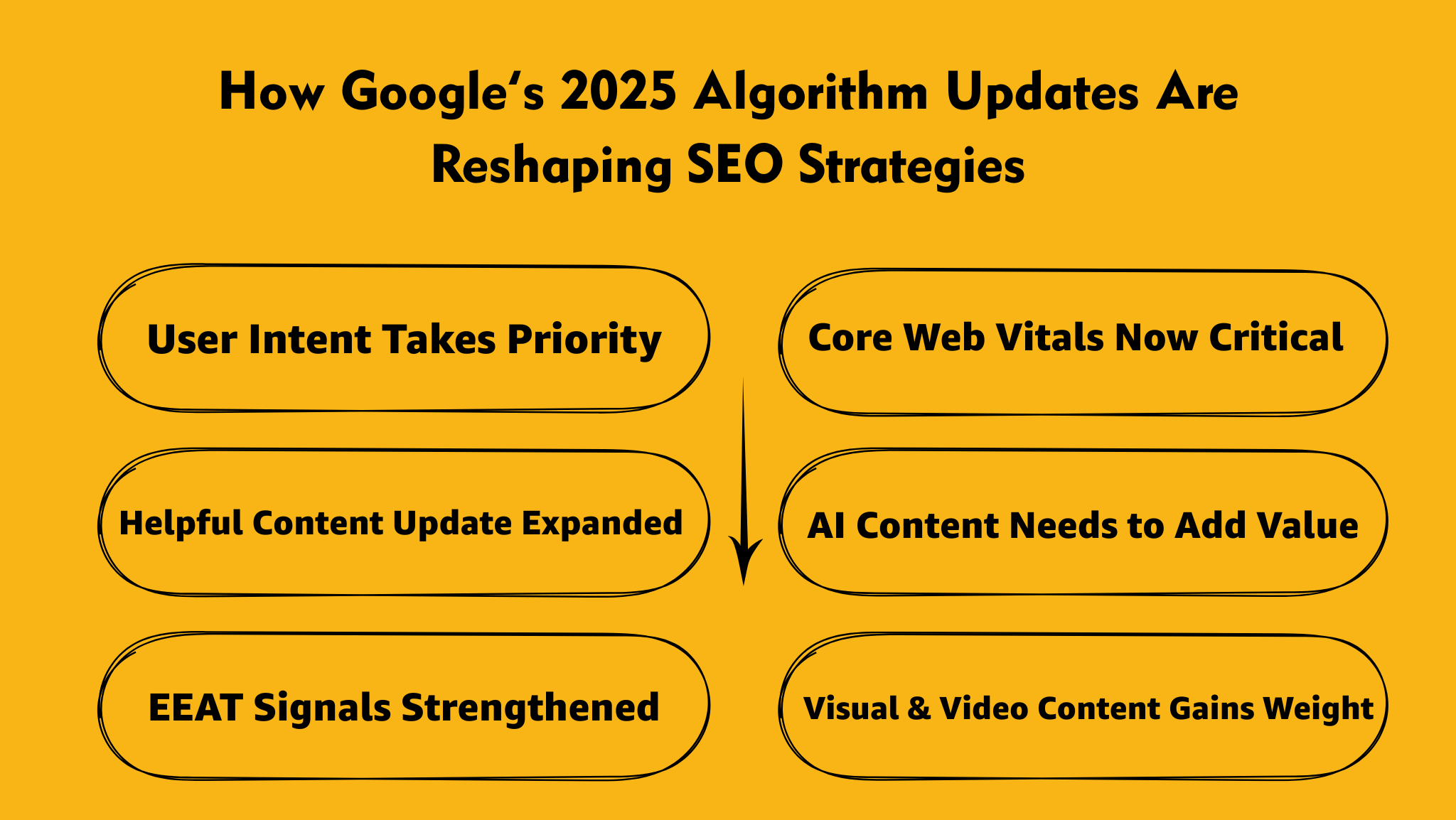
Conclusion: Google Algorithm Updates Reshaping SEO . Adapt or Get Penalized
Google’s 2025 algorithm updates represent a major evolution in the world of SEO. The focus has shifted from gaming the system with backlinks and keywords to delivering genuine value, great user experiences, and authoritative content. This demonstrates Google’s increased dedication to matching search engine rankings with user-beneficial content. To put it briefly, Google’s search engine is now a platform to present the most beneficial, pertinent, and reliable results available rather than merely a tool for finding websites.
This means that SEO is now a discipline based on user-centered thinking and long-term credibility rather than a game of strategies for companies and marketers. Techniques like backlink farming, keyword stuffing, and publishing a lot of thin material that could have been effective in the past are now disadvantages. Google is rewarding those who take the effort to provide insightful, thoroughly researched material that is supported by knowledge and experience.
There for Google Algorithm Updates Reshaping SEO strategies in many ways which made massive changes in Digital marketing and even though large amount of agencies were emerged in this disciple, some few like smart sites , ignite visibility and Trazi Creatives are only trying to keep their value and trying to be up to date in this area. they also trying to create future youngsters engaged in this fast paced digital marketing world by starting high qualified Academy’s like Trazi Digital Academy
A strong message was conveyed by the March 2025 Core Update: genuine participation counts. Despite having high backlink profiles, websites with antiquated designs, difficult navigation, or low interaction rates have witnessed a decline in their rankings. Meanwhile, platforms that embrace authenticity, transparency, and direct value to the user are climbing the SERPs. This is true across all industries—from e-commerce and education to healthcare and finance.
As AI-driven search features like Gemini and MUM become more integrated, optimization must also evolve to meet multimodal and zero-click behaviors. Voice search, image-based inquiries, and AI summaries should all be key components of SEO campaigns. In a similar vein, first-party data collecting and privacy-first marketing are now essential rather than optional.
In order to future-proof your SEO, you must remain adaptable and welcome change. Google will keep updating and improving its algorithm to support green hosting, sustainable practices, and highly customized search results. Early adapters will have a competitive advantage.
The message is straightforward yet impactful: Change or die. Creating digital ecosystems that offer enduring value is the goal of SEO in 2025 and beyond. You will succeed in this new period if your approach is honest, in line with the needs of your audience, and adaptable enough to welcome change.
Accept the change in order to improve your ranking and establish a stronger bond with your audience. Because trust and experience are the new SEO in this digital age, not just a component of it.
The message is straightforward yet impactful: Change or die. This is the era of user-focused, responsible, and intelligent SEO. Accept the shift, and benefits will come.
SEO experts must concentrate on long-term plans that put people first, employ AI sensibly, and get ready for a future dominated by relevance, performance, and transparency if they want to stay competitive.




No comment