
AI in Micro-Targeted Campaigns: Revolutionizing Marketing One Pixel at a Time
In the ever-changing world of digital marketing, tactics that once delivered strong results are now losing their edge. Enter AI in Micro-Targeted Campaigns: a paradigm shift that allows brands to reach audiences with razor-sharp precision. By using artificial intelligence to analyze user behavior, preferences, and online footprints, marketers are creating campaigns that feel personal, timely, and deeply relevant. In this blog, we will explore how AI in Micro-Targeted Campaigns is transforming marketing, its benefits, challenges, and how you can implement it effectively in your next campaign.
What is AI in Micro-Targeted Campaigns?
At its core, AI in Micro-Targeted Campaigns refers to leveraging AI algorithms—such as machine learning, deep learning, and predictive analytics—to segment audiences into ultra-narrow groups, often down to individual users or highly specific cohorts. Instead of broadcasting one message to many, micro-targeted campaigns deliver tailored content to smaller units: people based on browsing history, demographic microsegments, location patterns, or even moments in their customer journey.
For instance, an e-commerce brand might use AI in Micro-Targeted Campaigns to identify users who browsed a product page, placed it in their cart, but abandoned checkout. AI will trigger a personalized email or ad with a discount offer just when that user is most likely to convert. The result? More conversions, higher return on ad spend, and customer engagement that feels almost intuitive.
Why is AI in Micro-Targeted Campaigns So Powerful?
-
Precision and Personalization
Traditional targeting groups people broadly (e.g., “women aged 25-34 interested in fitness”). With AI in Micro-Targeted Campaigns, you can create highly refined clusters: women aged 28-32 who visited your fitness app 3× in a week, clicked on a specific workout, and whose past behavior suggests purchase intent. Such specificity drives engagement because users feel the brand understands them. -
Efficiency & Cost-Effectiveness
By targeting narrower audiences, marketers avoid wasting budget on uninterested users. AI continuously learns which segments respond best and allocates budget accordingly. AI in Micro-Targeted Campaigns ensures ad dollars are invested where they deliver the highest ROI. -
Real-Time Adaptation
AI models can adapt in real time. If engagement drops or a pattern shifts, the system updates targeting automatically. This feedback loop means AI in Micro-Targeted Campaigns remain effective even as market conditions evolve or consumer behavior changes. -
Scalability
Once set up, AI in Micro-Targeted Campaigns can scale across channels (email, social media, search, display) seamlessly. The same targeting logic can be applied to new campaigns, improving consistency and effectiveness as you scale.
Key Components of AI-Driven Micro-Targeting
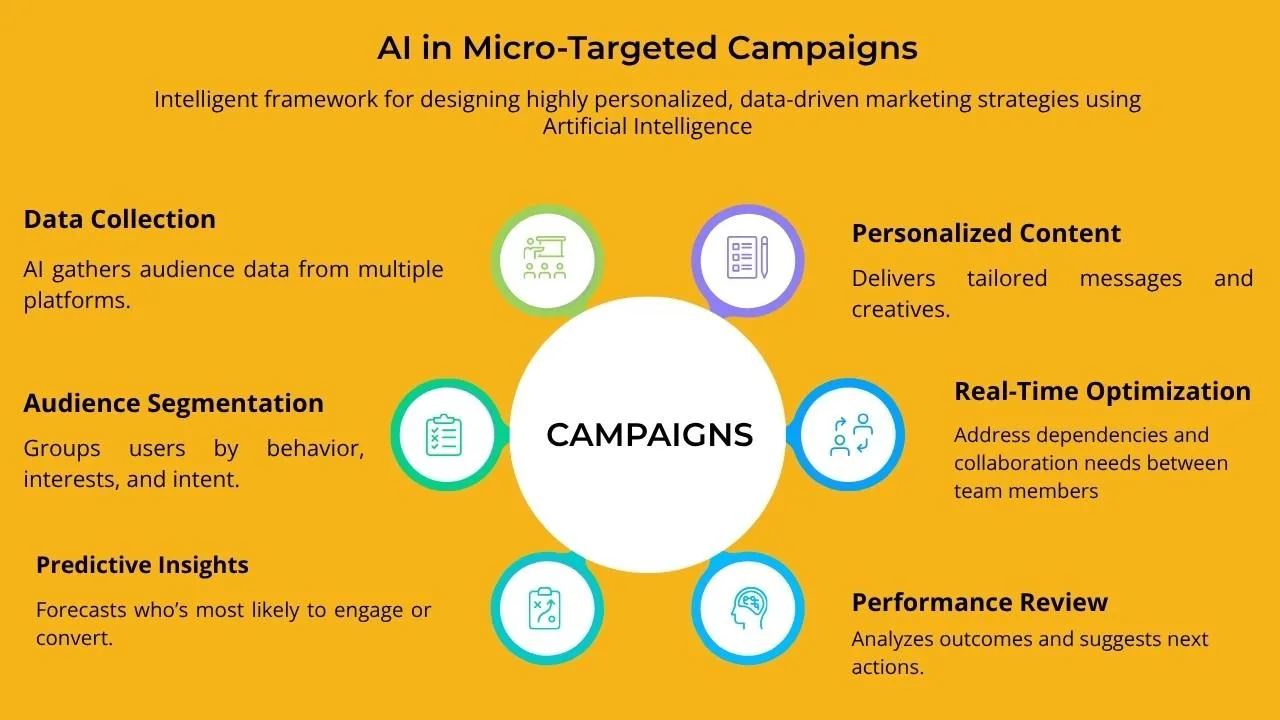
To harness AI in Micro-Targeted Campaigns, you’ll need several building blocks working in harmony:
-
Data Collection & Integration: Aggregate data from website analytics, CRM, purchase behavior, social media, and more. Unified datasets allow AI to build richer user profiles.
-
Feature Engineering: Translate raw data into features: e.g., visit frequency, time spent, product categories viewed, conversion propensity. AI uses these features to segment users effectively.
-
Model Training: Machine learning models (e.g. clustering, classification) learn to identify patterns in user behavior. For AI in Micro-Targeted Campaigns, clustering algorithms might discover niche segments you hadn’t anticipated.
-
Predictive Analytics: Predict who’s most likely to convert, churn, or take a desired action. AI then triggers personalized messages accordingly.
-
Campaign Delivery & Automation: Use platforms that support dynamic ads, programmatic bidding, or automation (e.g. Google Ads, Facebook Ads, email platforms). Connect your AI models to the delivery systems to run AI in Micro-Targeted Campaigns at scale.
-
Monitoring & Feedback: Track performance metrics like click-through rate, conversion rate, ROI. Feed results back into your models so AI in Micro-Targeted Campaigns improve over time.
Challenges & Ethical Considerations
While AI in Micro-Targeted Campaigns offers exciting possibilities, there are challenges and ethical issues to navigate:
-
Privacy & Compliance: Regulations like GDPR and CCPA restrict how data can be used. Marketers must ensure consumers’ consent and anonymize data where necessary when deploying AI in Micro-Targeted Campaigns.
-
Bias in AI: If training data is biased, models may reinforce unwanted stereotypes or exclude certain groups. It’s vital to audit AI systems regularly. Otherwise, your AI in Micro-Targeted Campaigns could unintentionally discriminate or alienate audiences.
-
Over-Segmentation: Too much targeting can lead to narrow groups too small to scale effectively. Marketers need balance when designing AI in Micro-Targeted Campaigns so that audience sizes remain viable.
-
Transparency & Trust: Users may feel uneasy if they realize they’re being tracked too closely. Brands should be transparent about data use and avoid creepy personalization.
How to Implement AI in Micro-Targeted Campaigns
Here’s a step-by-step to launching your first AI in Micro-Targeted Campaigns initiative:
-
Define Objectives
Do you want to increase conversions? Reduce churn? Boost engagement? Clarifying goals guides everything—model design, data features, and messaging. -
Gather & Prepare Data
Collect relevant data (web analytics, CRM history, customer interactions). Clean and preprocess it: remove duplicates, normalize values, fill missing data. Quality data is foundational to successful Artificial Intelligence in Marketing Campaigns. -
Segment via AI
Use clustering algorithms (e.g. K-means, DBSCAN) to find meaningful groups. Train classification models to assign new users to these segments automatically. -
Build Predictive Models
Train models to predict outcomes (conversion, churn risk). Use features engineered from historical data. Once trained, these models drive decision logic for your micro-targeted efforts. -
Personalize Messaging
For each micro-segment, craft messages (ads, emails, push notifications) that match their behavior, preferences, and position in the customer journey. Then deploy through automation tools. -
A/B Test & Optimize
Test different messages, delivery times, offers. Monitor metrics. Use insights to refine models and campaigns. AI in Micro-Targeted Campaigns become more effective when continuously optimized. -
Scale Up
After initial success, scale across channels: adapt micro-targeting logic for social media ads, search ads, display, even offline channels. Make sure systems talk to each other so that AI in Micro-Targeted Campaigns remain coordinated.
Real-World Examples
-
E-commerce Retargeting: An online fashion retailer used AI in Micro-Targeted Campaigns to retarget visitors who browsed shoes but didn’t purchase. The AI segmented them into groups based on price-sensitivity and brand loyalty, sending different offers accordingly. The result? A 25% lift in conversion rate.
-
Subscription Services: A streaming service used predictive models to identify users at high risk of churn. They sent personalized re-engagement emails—driven by AI in Micro-Targeted Campaigns—which reduced churn by 15%.
Future of AI in Micro-Targeted Campaigns
As AI technology advances, AI in Micro-Targeted Campaigns will evolve in exciting ways:
-
Hyper-real-time Targeting: AI will deliver messages at the perfect millisecond, reacting to user behavior instantly (e.g. showing an ad right after they abandon cart).
-
Multimodal Personalization: Combining text, image, audio, and even AR/VR content tailored in real time using generative AI.
-
Federated Learning & Privacy-First Techniques: Brands will deploy AI in Micro-Targeted Campaigns without collecting raw user data centrally—keeping privacy intact while preserving model performance.
-
Emotion-Aware Targeting: Cameras and sensors might read emotional cues and feed them into AI models, enabling campaigns that adapt based on user mood.
 Conclusion
this tool isn’t just the future—it’s already here. Marketers who harness this power can deliver more relevant content, boost ROI, and build stronger relationships with customers. But success depends on high-quality data, ethical practices, and continual optimization. If you’re ready to elevate your marketing strategy, embracing AI in Micro-Targeted Campaigns may just be the key.
Grow your business with our Digital Marketing Services
For more information, visit Google Digital Garage




No comment