
If you’re trying to grow your website and improve its visibility on search engines, you’ve probably heard the term domain authority. But why is it important, and what does it actually mean?
Understanding Domain Authority
Domain Authority (DA) is a search engine ranking score developed by Moz — one of the most trusted names in SEO. A website’s likelihood of showing up in search engine results can be predicted using the Moz domain authority score, which goes from 1 to 100.
It’s a measure of your website’s overall strength and position in search engine results, to put it simply. The higher your domain authority, the better your chances of ranking well for competitive search terms.
What Influences Domain Authority?
Moz domain authority is calculated using a range of factors, with the most important being the quality and quantity of backlinks — links from other websites that point to yours. But that’s not all. Here are some key elements that affect your DA:
- Link Profile: Getting backlinks from well-known, trusted websites boosts your domain authority more than links from low-quality or irrelevant sources.
- Site Age and Consistency: Older websites with a steady history of publishing valuable content tend to have higher scores.
- Content Quality: Useful, well-written content that earns natural links from other sites plays a big role.
- User Experience: Websites that are mobile-friendly, fast, and easy to navigate often perform better in search rankings.
Why is Domain Authority Important?
Domain authority is a useful statistic even though Google does not utilize it directly as a ranking factor. It gives you an idea of where your website stands compared to others in your industry. It can also guide your SEO strategy — helping you understand what areas need improvement to grow your search visibility.
Suppose your website has a domain authority (DA) of 25 and your biggest competitor has a DA of 45. That tells you there’s room to grow, and that working on your backlink strategy, content, and site performance could help close the gap.
How to Improve Domain Authority
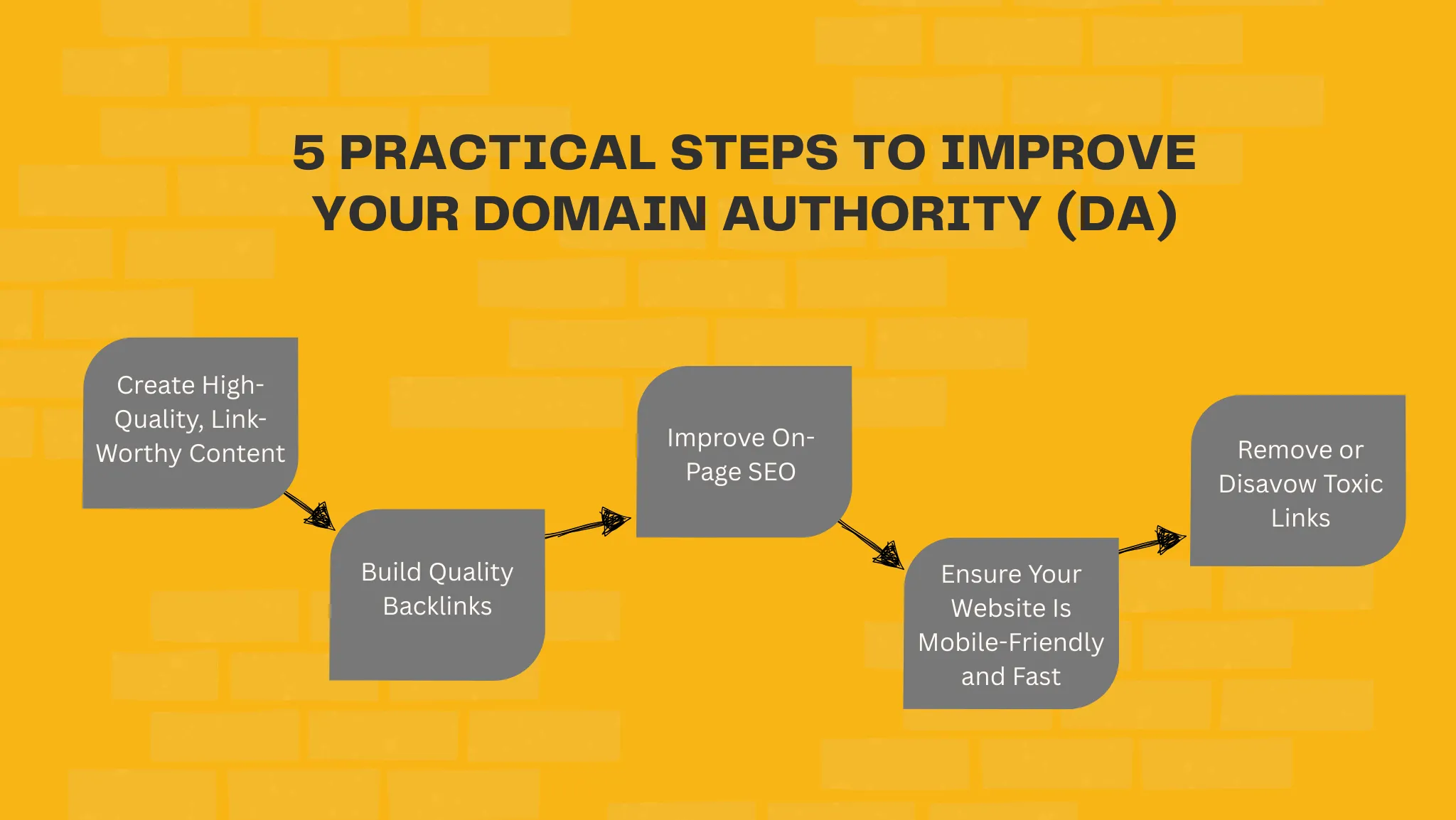
Building domain authority takes time, but here are some practical ways to do it:
- Create Quality Content: Offer real value to your readers — whether it’s through helpful blog posts, guides, or how-to articles.
- Earn High-Quality Backlinks: Focus on building relationships, contributing guest posts, or getting featured on reputable sites in your field.
- Fix Technical Issues: Make sure your website is mobile-friendly, loads quickly, and has a clean structure.
- Stay Active and Consistent: Regularly update your website with new, relevant content that engages your audience.
Final Thoughts
So, what is the domain authority? In short, it’s a helpful metric that gives you a snapshot of your website’s credibility and ranking potential. While it’s not the only factor that matters in SEO, tracking your Moz domain authority can give you useful insights and help guide your efforts as you work to grow your online presence.
What is Meant by Domain Authority?
In the world of digital marketing, the term domain authority often comes up when discussing search engine rankings. But what is meant by domain authority, and why is it important for your website’s success?
Understanding Domain Authority
A score that indicates a website’s strength and reliability is called domain authority, or DA for short. It was developed by Moz to help website owners understand how likely their site is to rank in search engine results compared to other sites. The ranking potential rises as the score does, from 1 to 100. the ranking potential also increases.
This score is based on several factors, including the number of backlinks, the quality of those links, and how trustworthy your website appears to be in the eyes of search engines.
Why Does Domain Authority Matter?
The reputation score of your website can be thought of as domain authority. Just like people tend to trust well-known brands, search engines are more likely to rank websites that have built authority and trust. Stronger online presence, increased organic traffic, and improved visibility can all result from a higher domain authority.
But it’s not just about chasing a high score. The goal is to build real credibility over time by creating useful content and earning trust from both users and other websites.
What is a Good Domain Authority?
What constitutes a good domain authority is a question that many website owners ask. The answer depends on your industry and competition. For small businesses or newer websites, a DA score between 20 and 40 is a healthy starting point. Well-established sites often score above 60.
Instead of focusing only on the number, it’s more helpful to compare your domain authority with competitors in your niche. If your competitors have a DA of 45 and yours is 30, your goal should be to gradually close that gap.
Factors That Influence Domain Authority
Several key elements affect your website’s domain authority:
- Quality Backlinks: Earning links from trustworthy, high-authority websites significantly boosts your score.
- Content Value: Publishing informative, original, and well-written content attracts readers and backlinks.
- Site Performance: Fast loading speed, mobile-friendliness, and easy navigation all play a role.
- Link Profile Health: Having a clean, spam-free link profile helps maintain and grow your authority.
How to Improve Domain Authority
Enhancing domain authority takes time and is not a quick cure. Here are a few practical steps:
- Create Shareable Content: Articles, guides, and infographics that offer value are more likely to earn backlinks.
- Build Relationships: Partner with reputable websites in your industry for guest posts and collaborations.
- Fix Technical Issues: Make sure your site runs smoothly, loads quickly, and is secure.
- Stay Consistent: Regularly update your site with fresh content and monitor your backlink profile.
Final Thoughts
To wrap it up, understanding what is meant by domain authority helps you make smarter decisions for your website’s growth. While it’s just one part of SEO, it offers a clear picture of how your site stacks up against others. Focus on building trust, creating value, and staying consistent — and your authority will naturally grow over time.
What is an Example of a Domain Authority?
When trying to understand how websites rank on search engines like Google, you might come across terms like domain authority and page authority. These terms are useful for evaluating how strong a website is and how well it might perform in search results. But in reality, what do they mean? Let’s break it down and look at an example to help make it clearer.
What is Domain Authority?
The probability that a website as a whole will show up in search engine results is indicated by a figure known as domain authority (DA). The score ranges from 1 to 100. A website is more authoritative and more likely to rank highly if it has a higher number.
For example, websites like bbc.com, wikipedia.org, and amazon.com have extremely high domain authority — often close to 100. That’s because they have thousands of high-quality backlinks, strong content, and long-standing reputations. On the other hand, a brand-new website may start with a DA of 1 and gradually build up over time.
So, if you’re wondering what is an example of a domain authority, just look at how trusted and well-established sites like Wikipedia rank for a wide variety of topics — that’s high DA in action.
What is Page Authority?
Page authority (PA) concentrates on specific web pages, whereas domain authority describes the overall strength of a website. It also uses a 1 to 100 scale. For instance, a homepage might have a high page authority because many other sites link to it. But a new blog post on the same site might have a lower PA until it gains backlinks or traffic.
Domain Authority vs Page Authority
Understanding the difference between domain authority vs page authority is important for improving your SEO strategy.
- The ranking potential of the full domain, such as example.com, is measured by Domain Authority.
- Page Authority looks at the ranking potential of a specific URL (like example.com/blog/seo-tips).
If your domain has a high DA, new pages you publish are more likely to rank faster. But even if your domain authority is low, a single page can still rank well if it’s optimized and gains strong backlinks.
Why Does This Matter?
Both DA and PA help website owners, marketers, and bloggers understand where they stand and what they can improve. They’re especially helpful when analyzing competitors or planning content strategies. For example, if your competitor’s domain has a DA of 60 and yours is 30, you know you’ll need to work harder on building quality backlinks and improving your site’s authority.
Final Thoughts
So, what is an example of a domain authority? Think of a well-known, trustworthy site like Wikipedia — that’s domain authority in action. Understanding both what is page authority and the difference between domain authority vs page authority gives you a better picture of how search engines view your site and its pages. Use this knowledge to focus on creating valuable content, building strong links, and improving your site’s structure — and over time, both your DA and PA will grow.
What is DR and PR in SEO?
When it comes to search engine optimization (SEO), there are many terms that can feel a bit confusing at first. Two of these are DR (Domain Rating) and PR (PageRank). Both play a role in how search engines view and rank websites, but they work in different ways. Let’s break them down in simple terms.
What is DR (Domain Rating)?
Ahrefs, a popular SEO tool, created the Domain Rating (DR) measure. It measures the strength of a website’s backlink profile on a scale from 0 to 100. In other words, DR reflects how strong and trustworthy your site looks based on the quality and number of links from other websites.
Your DR score will increase as more reputable websites link to your domain. For example, if popular and trusted sites are linking to your website, it tells search engines that your content is valuable — and that can help improve your rankings.
Keep in mind that DR is a third-party metric, not something Google officially uses, but it’s still a helpful way to gauge your website’s authority in comparison to others.
What is PR (PageRank)?
Google’s founders initially created the PageRank (PR) method to rank web sites. It was one of the earliest and most important factors in how Google determined which pages should appear at the top of search results.
Both the quantity and quality of links going to a page are taken into account by PR. The idea is that a page linked by many other valuable pages is likely to be important itself. Although Google no longer shows public PageRank scores, the concept still influences how the search engine values links and determines relevance.
While PageRank isn’t visible anymore, its principles still matter: strong, relevant links are one of the best ways to improve your website’s SEO performance.
What Is the Difference Between Domain Authority and DR and PR?
Many people also ask: What is the domain authority in SEO, and how is it different from DR and PR?
Domain Authority (DA), created by Moz, is similar to DR in that it estimates how likely a website is to rank in search engine results. It’s also based on backlink strength, but it uses a different formula.
Authority is estimated using third-party indicators, such as DA (Moz) and DR (Ahrefs).
PR (PageRank) is a concept from Google, though no longer publicly updated.
All three help marketers understand how strong a site or page is in the eyes of search engines.
Final Thoughts
To sum up, DR and PR are two ways to measure the strength of your website or a specific page in SEO. While DR focuses on overall domain strength and PR emphasizes link quality, both are built on the same idea — that high-quality links improve your visibility.
Understanding these metrics, along with what is the domain authority in SEO, can guide you in building a stronger, more competitive online presence. Focus on creating valuable content and earning trustworthy links — and your scores will naturally improve over time.
Follow us on Instagram for daily digital marketing tips, trends & updates. Join the community – tap to follow now!
What Is Domain Authority?
Domain Authority (DA) is a score that predicts how likely a website is to rank on search engines like Google. It’s not given by Google itself — and it’s not an official ranking factor — but it’s still widely used by marketers and website owners to measure a site’s SEO strength.
The score ranges from 1 to 100, and the higher your number, the stronger your domain’s perceived ability to rank.
Who Gives Domain Authority?
Moz, a well-known brand in the SEO tools and analytics space, creates and offers Domain Authority. Moz created the domain authority score to help website owners understand how their site stacks up against competitors in terms of search engine ranking potential.
It’s crucial to keep in mind that search engines do not control domain authority. Instead, it’s a third-party metric based on data collected by Moz, such as the number and quality of backlinks pointing to your site.
So, while no official organization gives domain authority, Moz is the source that created and calculates this score using their own algorithms and ranking models.
Why Does It Matter?
Even though domain authority isn’t a direct ranking factor used by Google, it still gives valuable insight into how trustworthy and authoritative your site looks to search engines — especially when compared to your competition.
For example, if your website has a domain authority of 25 and your competitor’s site has a DA of 45, it’s a sign you may need to build more quality backlinks or improve your content to compete more effectively in search rankings.
How to Increase Domain Authority
Now that you know who gives domain authority, the next question is: How to increase domain authority?
Here are some proven, practical steps:
Earn Quality Backlinks
One of the most crucial elements is the presence of backlinks from trustworthy, authoritative websites. Focus on building real relationships, guest posting, and getting featured in trustworthy publications.
- Create Valuable Content
Publish content that answers questions, solves problems, and provides real value. Great content naturally attracts links and improves engagement. - Fix Technical Issues
Make sure your website loads quickly, is mobile-friendly, and has a clean, user-friendly structure. These factors help with both SEO and user experience. - Stay Consistent
Consistently adding helpful, relevant content keeps your site active and encourages steady growth in authority.
Avoid Spammy Practices
Stay away from buying links or using shady tactics. These can actually hurt your domain authority in the long run.
Final Thoughts
So, who gives domain authority? Moz, a reputable supplier of SEO software, is the solution. And while it’s not an official ranking factor, it’s a useful way to measure your site’s growth and competitiveness. If you’re wondering how to increase domain authority, focus on building trust, earning quality backlinks, and providing real value to your audience — and the results will follow.
Is DA Important for SEO?
If you’ve been exploring ways to improve your website’s search performance, chances are you’ve come across the term Domain Authority (DA). But many people still wonder, Is DA important for SEO? The short answer is: yes, but with some context.
Let’s unpack what domain authority really means, how it affects your SEO strategy, and how tools like a domain authority checker can help you track your progress.
What is Domain Authority?
Domain Authority is a metric created by Moz that predicts how well a website might rank on search engines. It’s scored on a scale from 1 to 100. The higher the score, the stronger your domain is considered in terms of trust and credibility.
For example, websites like bbc.com or wikipedia.org have DA scores close to 100 because they’ve built years of credibility, strong backlinks, and useful content.
But keep in mind — Google does not use DA as a ranking factor. It’s a third-party estimate, not an official signal. Still, it’s useful for comparing your site to others and planning your SEO strategy.
So, Is DA Important for SEO?
While DA isn’t a direct ranking factor, it gives valuable insight into your website’s overall SEO strength. Here’s why it’s still important:
- Competitive Benchmarking
DA helps you compare your site with others in your niche. If your competitor’s site has a DA of 45 and yours is 25, you’ll know there’s work to be done to catch up. - Backlink Strategy
Building quality backlinks is one of the best ways to improve SEO. DA gives you an idea of how effective your link-building efforts are over time. - Tracking Progress
Using a domain authority checker, you can monitor whether your efforts—like publishing content or earning backlinks—are having a positive impact. - Influencer and Partnership Evaluations
If you’re doing outreach, guest blogging, or collaborations, checking the DA of other websites helps you target high-quality, trustworthy partners.
How Can You Check Your DA?
You can easily check your domain authority using free tools online. Just search for “domain authority checker” and you’ll find platforms like Moz, Ahrefs, and others that offer instant DA reports. All you need is your website URL.
These tools also often show related metrics like page authority, backlink count, and referring domains, giving you a fuller picture of your website’s SEO profile.

Want to grow online? Explore our Digital Marketing Course and start your journey today – learn more now!
Final Thoughts
So, is DA important for SEO? While it’s not a direct ranking factor, domain authority offers a helpful snapshot of your website’s strength and growth potential. It helps you understand how your site stacks up, where you stand among competitors, and where you need to improve.
Using a domain authority checker regularly is a smart way to stay informed and focused. Just remember, the best way to boost your DA—and your SEO—is to consistently create valuable content, build high-quality backlinks, and offer a great user experience.
Stay patient and consistent, and your authority will grow naturally over time.




No comment